|


|
| Reprinted from WHSU Public Radio By Jeniece Roman, WSHU, Photos: Jeniece Roman / WSHU
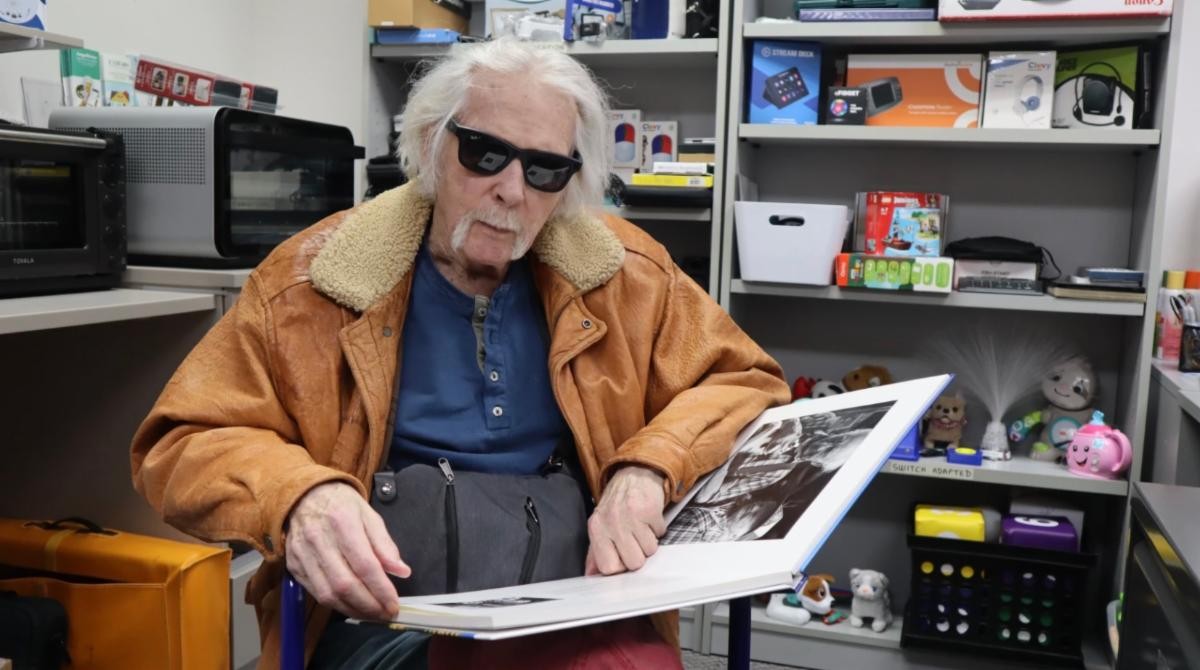
After a long career as a photographer, a Connecticut man had to come to terms with the gradual loss of his eyesight. However, with the help of new technology, he’s reconnecting with the world. Jack McConnell has been a commercial photographer for over 50 years. McConnell was diagnosed with diabetic retinopathy, an eye disease caused by diabetes that brings gradual vision loss. Now he’s completely blind in one eye and can only see dark shapes and light in the other. “A year ago, I could see the trees across the way, with their incredible branches and leaves and green dancing to the breeze of a springtime day. Not anymore. It’s black. It’s dark gray. There’s nothing there,” McConnell said. Before his condition, McConnell traveled the world to meet interesting people and embedded himself in different communities. From traveling on a container ship in the North Sea to taking photographs of locals on an island off the coast of Maine, McConnell has taken roughly 250,000 images throughout his career. He said the shift has been a difficult change in his life. “When something happens, you either fight it or you deal with it. And I’ve had to learn to deal with it,” McConnell said. Then, a friend of McConnell recommended he visit UCP of Eastern Connecticut, a nonprofit center that provides programs for people with disabilities. Patients are then matched with programs and services based on various factors. The center has a lending library where people can rent assistive technology to try before purchasing. 
|
by Stacey Fulton, EASTCONN
A student diagnosed with Dyslexia, poor phonological awareness, impacted by ADHD and speech apraxia was referred to EASTCONN for an AT evaluation, specifically focused on written expression. (The student was using some tools for accessing text and more recommendations were added for reading as a result of the evaluation.) Her handwriting was legible, but due to her very poor phonological awareness, it was difficult to decipher what she was trying to say. Prior to requesting an AT evaluation, the student was utilizing Read & Write’s word prediction feature on a Chromebook, but she was taking excessive amounts of time to complete writing tasks, resulting in frustration and eventually shutting down.
One issue was that the student had significant difficulties and took excessive amounts of time just logging into her Chromebook (even when provided with a visual of information for her account). Once logged in, she had difficulties finding the keys on the keyboard quickly. The student was bright, creative and had great ideas, but even the simplest words required a lot of effort and energy for her to spell despite the assistance of Word Prediction.
When using the word prediction, she was usually able to come up with the first letter of a word. Each time she typed a letter, she used the text-to-speech features to listen to the long list of words predicted. This required extensive time and energy and the student often became so frustrated, she was allowed to dictate her sentences while the staff scribed for her. Speech-to-text was also trialed by the district using Voice Typing (Google Docs), but because of her poor articulation, there were a significant number of errors (at the one-word level and sentence level). It was felt that AT programs that provided the words (like Clicker Writer) would limit her ideas and creativity.
EASTCONN’s evaluator trialed Co:Writer Universal using topic dictionaries. Use of the topic dictionaries significantly helped this student as the words she wanted to use came up quickly (after 1 or 2 letters) and she was able to select the correct word by listening (out of a choice of 5). In addition, this evaluator trialed Co:Writer on the iPad and found that the student was quicker and more efficient with finding the letters on the on-screen keyboard and accessing the predicted words above the keyboard.
With everything in the same visual plane and no login, she became much more efficient. With the help of these tools, the student can be more independent and successful with some writing tasks, lessening the frustration and increasing the confidence in herself.
After a period of time using the recommended tools, the teacher reported: “EASTCONN found tools to unlock so many reading and writing tasks. They loaned us an iPad from their lending library (which proved to be a gamechanger, versus third grade’s traditional use of a Chromebook). After practicing in the resource room, she has now generalized her use of the AT into the general education classroom.”
 Children with autism have always had to change for the world; but now the world is starting to change for them! Devoted to improving the lives of children with autism through Robot-Assisted Instruction, MOVIA Robotics is an innovative tech company that designs products for both the home and school environment. MOVIA’s Robot-Assisted Instruction (RAI) system integrates cutting-edge software and evidence-based curriculum delivered through captivating robotics platforms to engage children with autism in order to improve outcomes. The RAI system supports a pre-programmed curriculum with the ability to uniquely configure the experience based on each child’s educational and social-emotional learning goals. What’s more, MOVIA’s dedicated team of experts works with each family or classroom to tailor the experience to the individual, making sure each child is given all the tools he or she needs to succeed.

MOVIA is also beginning to work with older students with autism, as they learn to transition from school to prevocational services and will eventually work with adults in vocational settings as well.

Learn more on the Movia Robotics website.

 The TouchChat app was recently trialed through EASTCONN’s AT Lending Library by Chris, a transition-age student with Autism Spectrum Disorder. Several AAC options were ruled-out prior to Chris’s device trials, after matching specific software design features to his abilities and needs. For example, Chris had demonstrated his ability to make requests to meet his needs and he had a large, receptive vocabulary. Yet, he was often impatient, so he benefited from automatic navigation and grammar guidance to produce full sentences quickly. Trials began with Chris observing the examiner using an 8-inch dynamic display, speech-generating device (SGD) with synthesized voice-output running research-based AAC software, called TouchChat. TouchChat is designed and manufactured by Saltillo for individuals who need efficient access to a robust vocabulary with a mix of single words, phrases and complete sentences. It is an app for iOS only, not Android devices. Chris’s support coach said he needed the smaller size of the 8-inch iPad, as compared to his current, 10-inch SGD. Chris enjoyed using the custom messages in the About Me page to express how he liked ketchup and other favorites. He quickly demonstrated the ability to imitate a model, and even learned to sequence three buttons independently to express, “I want to play music.” As a result of Chris successfully trialing several assistive technologies and devices, his school district could determine which device would best meet his needs.